Powered by Open Standards: Introducing the Arizona Water Observatory
By: Center for Geospatial Solutions
Modern data infrastructure increases the usefulness of water data and enables its broadest possible application. – The Internet of Water Principles
The Internet of Water Coalition vision – a shared, accessible water data ecosystem – hinges on the thoughtful development of technical applications informed by both data users and interoperable standards. Building such a water data network requires expert technologists, deep communication, and concerted passion, and in Arizona, Arizona State University's Center for Hydrologic Innovation and the Center for Geospatial Solutions (CGS) are finding success. Their collaboration on the Arizona Water Observatory (AWO) will open new doors to data for Arizona water data users and help chart a path for how other states can modernize their own water data to increase accessibility and usability.
Introducing the Arizona Water Observatory
While more data providers have produced portals to explore their data and increase accessibility, the next step in building a true data network is creating a space where data from multiple sources are findable and comparable without unique integrations for each source. The AWO provides this as a centralized, open-source web platform that standardizes data from various sources to help data users find and analyze critical water data. 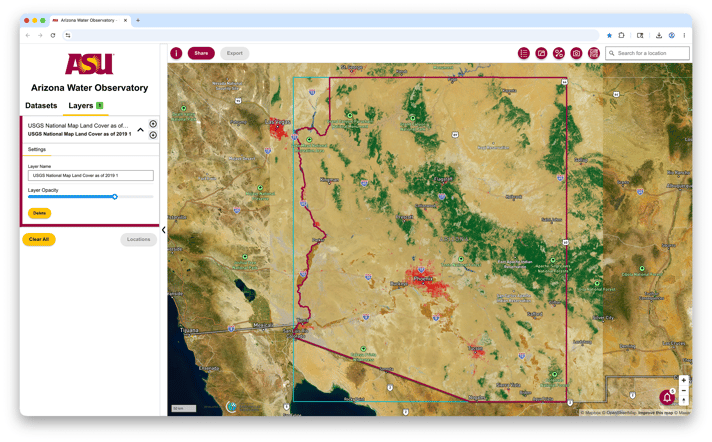
Utilizing OGC interoperability standards, the AWO removes “data drudgery” from the workflow of data users. Rather than sifting through data folders or learning new APIs for each data provider, the AWO standardizes API metadata and access patterns, so users can find data easily and repeatedly from sources including USGS, NOAA, SNOTEL, and more. From there, users can take advantage of in-platform visualizations and variable comparisons to aid in their analyses. Multiple options for data formatting also allow users to export data for reuse across modeling and GIS tools.
Additionally, the open source foundation of the platform encourages AWO usage and adoption. Although there may be a learning curve as users begin using the AWO, the long-term benefits outweigh the costs. Accessing so much data from a single API, beginning analyses in platform, and formatting exports into preferred workflows saves resources for individuals and agencies alike. And because the platform is built to grow, knowing the entry point to these data only becomes more valuable over time.
In short, the AWO unlocks live data from trusted but disparate sources so that users can find, analyze, and export data in a single platform, saving significant time and processing power along the way.
Scaling for the Future
The needs of water data users vary with each data user themself, which can make building relevant and functional tools tricky. Although there isn’t a one-size-fits-all tool, creating platforms like AWO with the intention to scale prepares the platform to address current and future data needs.
In practice, this meant multiple workshops with AWO stakeholders to determine their priorities and what the platform needs to be useful today, as well as a backend developed with a modular architecture to support future additions of new datasets and tools. Even as the AWO team continues refining the application ahead of its 2026 public launch, they’re already adding new datasets to widen the scope of accessible data.
As more states look to modernize their water data infrastructure, the AWO offers an optimistic roadmap. The successful implementation of OGC standards demonstrates how powerfully open standards can change the data landscape by making data more accessible and reusable. Once a data source adheres to OGC APIs and can work in concert with other sources, experienced technical users will be able to find and use data without specialty-built platforms as well, meaning states can develop access routes into critical data without overhauling their existing data portals. With a modular approach based in open source standards, states can look to the development of the AWO as a model to help guide their own water data management.
Launching the AWO
The AWO publicly launched in August 2026 for all to use. Whether you’re interested in Arizona water data or simply seeing the AWO in action, we’ll have more to share. Stay tuned to IoW, CGS, and ASU channels for updates about the platform and its launch.
Want to explore further? See the AWO in action through the Internet of Water webinar series, or learn more about the platform, its development, and its capabilities on the ASU website.
Comments on this post